
An options strike price is the set price at which an option allows you to buy (in the case of a call) or sell (in the case of a put) the underlying asset. Whether your option ends up profitably depends on how the strike price compares to the current market price at expiration. It’s a crucial piece of every option contract, shaping both its value and your potential return.
What Is a Strike Price?
When you’re trading options, there are a few choices that matter right away. You’ll decide if you’re buying a call or a put. You’ll pick how long the option will last (expiration date). And just as important, you’ll choose the strike price.
That strike is the fixed price you’re locking in. The number that says, no matter where the market goes, you have the right to buy or sell this stock at this level, anytime before the option expires.
- A call option gives you the right to buy the stock at that strike.
- A put option gives you the right to sell the stock at that price.
Let’s say you’re feeling bullish on Apple. The stock is trading at $200. You could buy shares. Or you could use leverage and buy a call option instead. Maybe you choose a $205 strike call with a one-month expiration. That means you now hold the right to buy Apple at $205 per share at any point in the next month, event if the stock shoot to $210 or $220.
If Apple rises to $210, suddenly your option starts to mean something. You now have the ability to buy the stock for $5 less than the current market price. Now, just because the stock goes above your strike doesn’t mean you’re instantly making a profit. You still paid for the option up front, but we’ll get into that cost later. For now, understand this: a call locks in your buy price. A put locks in your sell price.
That same principle works for protection, too. Suppose you own shares of Google, and it’s trading at $180. You’re worried the price might drop. So, you buy a $170 put. That option guarantees you can sell your shares for $170, even if the stock plummets.
That’s all an options strike price is. A price you’ve locked in ahead of time to buy or sell the underlying stock.
How Strike Price Works in Options
The strike price is more than just a contract detail. It’s one of the most important factors that shapes how your option behaves, how it responds to market changes, and ultimately, how it makes or loses money.
It’s not the only factor that matters. You’ve still got time until expiration, volatility, and even interest rates playing their part. But the strike price is the foundation. It defines where your position stands in relation to the market, and everything else reacts around it.
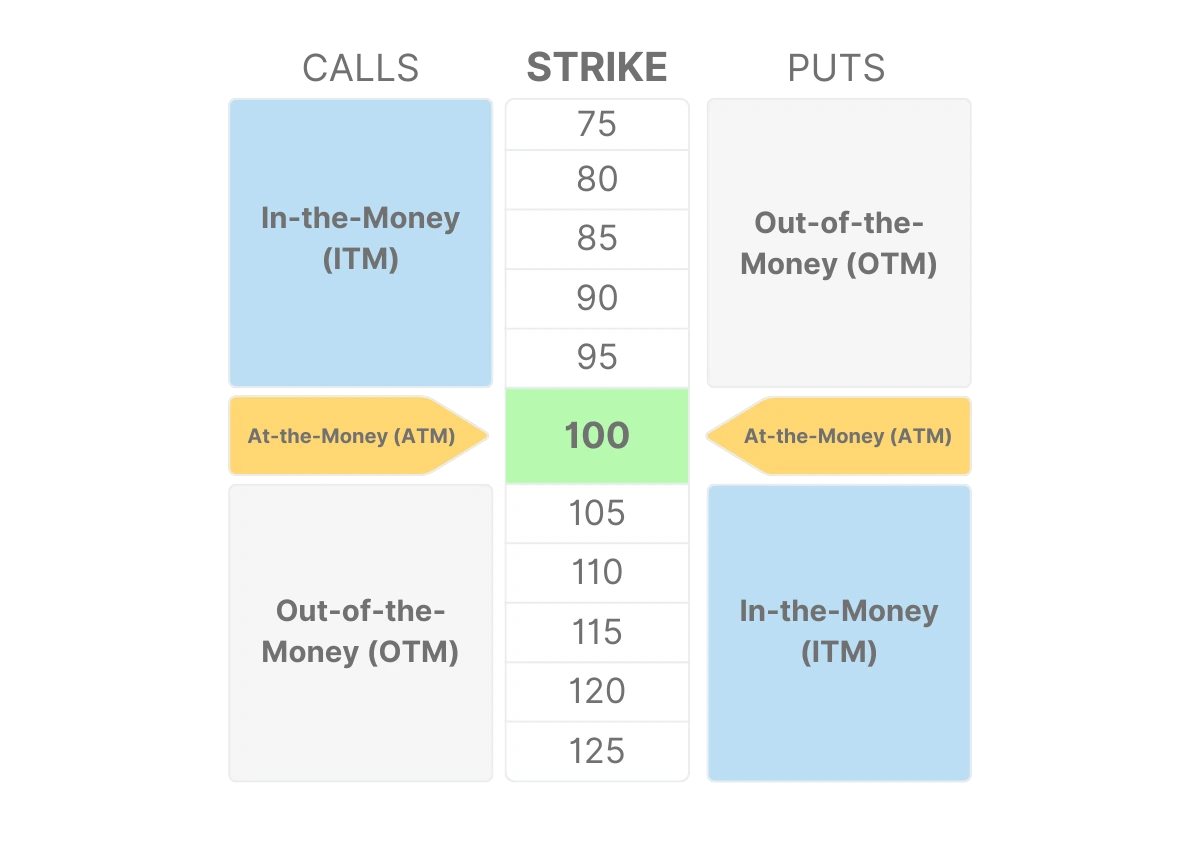
For call options, the value grows when the stock price goes up. For put options, the value grows when the stock price drops. Simple enough. But the strike price you choose, whether it’s in-the-money (ITM), at-the-money (ATM), or out-of-the-money (OTM), changes how your option behaves.
| Strike | Stock Price Movement | Time Passing (Theta) | Volatility Change (Vega) |
|---|---|---|---|
| In-the-Money (ITM) | Responds steadily, high delta (moves with stock closely) | Less affected by time decay, slower loss | Less sensitive to volatility changes |
| At-the-Money (ATM) | Highly responsive, largest gamma (value can change rapidly) | Moderate time decay, accelerates near expiry | Most sensitive to volatility, large premium changes |
| Out-of-the-Money (OTM) | Low delta, minimal movement unless stock moves a lot | Highly affected by time decay, value erodes fast | Highly sensitive to volatility changes, value can jump on IV spike |
An in-the-money call option, like one with a $40 strike when the stock is $50, already has real value because you could buy the stock cheaper than it’s trading. These options move closely with the stock, so they’re safer but cost more upfront. You get less chance for big gains, but it’s more like owning the stock itself.
An at-the-money option has a strike price close to the stock’s current price, like a $50 strike when the stock is $50. These options are right on the edge, so their value can change quickly with small stock moves. This makes them appeal to short-term traders who expect the stock to move soon.
An out-of-the-money option, like a $60 strike call when the stock is $50, has no real value yet, it’s all potential. These are cheaper, which makes them tempting, but they’re risky. They lose value fast as time passes, and the stock needs to move a lot to make them worth something.
That’s why choosing your strike price isn’t a casual decision. It depends on how confident you are in the stock’s direction, how long you plan to hold, and what the volatility looks like. If you’re swinging for a big move, you might go out-of-the-money. If you want safer exposure with more stable pricing, you go in-the-money. Time, volatility, and direction all matter. But it’s the strike price that decides how those elements come together.
Moneyness of an Option
When traders talk about an option being “in-the-money” or “out-of-the-money,” they’re not just using jargon. They’re describing how an option’s strike price compares to the current price of the stock it’s tied to. This relationship is called moneyness, and plays a major role in how an option is valued, how it behaves, and how traders use it in real strategies.
In the Money (ITM)
An option is in-the-money when exercising it would have immediate value. For call options, this means the stock is trading above the strike price. For put options, the stock is below the strike.
Take a $50 call. If the stock is at $55, the option is $5 in-the-money. That’s $5 of intrinsic value, real value you’d gain if you exercised it. In-the-money options are more expensive because they already contain this built-in value. They’re also less risky than out-of-the-money options because they don’t rely purely on future movement to hold value.
Out of the Money (OTM)
An option is out-of-the-money when it has no intrinsic value. It’s all speculation. For calls, this includes strikes above the current stock price. For puts, it’s all strikes below the current price.
Take that same $50 call. If the stock is trading at $45, the option is out-of-the-money. You wouldn’t want to use it to buy the stock right now because you’d be paying more than the current market price. That doesn’t mean it’s worthless though. It still has extrinsic value (time, volatility, potential).
At the Money (ATM)
An option is at-the-money when the stock price is equal to or very close to the strike price. A $50 call with the stock sitting around $50 is considered at-the-money.
These options don’t have much intrinsic value (if any), but they tend to have the most time value. They’re also highly sensitive to price movement, which makes them popular with traders looking for quick directional plays. Small moves in the stock can quickly shift the moneyness, and with it, the value of the option.
Strike Price Example
Let’s say you’re watching the stock Nvidia. Right now, it’s trading at $140 per share. You think it’s going higher. Maybe a lot higher. Instead of buying 100 shares outright, which would $14,000, you decide to look at the options.
You find a call option with a strike price of $150, set to expire in three months. The price of that option is $3. Since each option contract covers 100 shares, your total cost is $300.
A few weeks goes by. News breaks. Nvidia jumps to $165.
Now your $150 call is deep in-the-money. You’ve locked in the right to buy shares at $150, even though they’re trading at $165. That $15 difference is all intrinsic value. The option itself is worth $15 per share, or $1,500 per contract.
You paid $300. Now it’s worth $1,500. That’s a $1,200 profit.
You have a few choices. You can continue holding if you think the stock will rise further. You could sell the option and collect the gain. Or you could exercise it. That means buying 100 shares at $150 a share, a $15,000 total cost. Then immediately selling those shares at $165 bring in $16,500. Subtract your original $300 and you’ve still got that same $1,200 gain.
This is what the strike price controls. It defines your purchase price. If the market rises, you gain leverage. If it doesn’t, your option expires worthless and you’re out the premium. That’s the tradeoff.